With XRP price having returned to a crucial multi-year support level following its 2025/2026 bear market, the token’s withdrawal transactions have spiked to their highest share in more than five years.
On July 31, Binance’s seven-day XRP withdrawal transaction share surged to 55.6%, the highest level since February 2021. Additionally, the same metric across all centralized exchanges hit 54%, also marking the highest share in about 65 months, according to data from CryptoQuant analyzed by pseudonymous crypto trader Amr Taha.
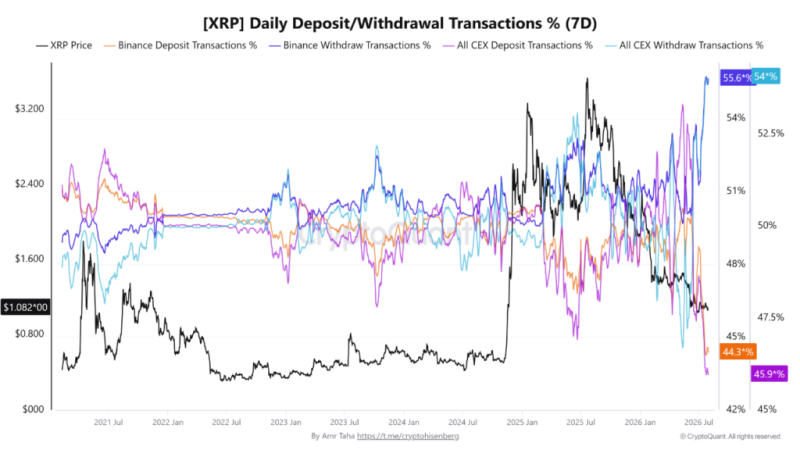
7-day % of XRP daily deposits/withdrawal transactions. Source: CryptoQuant
Concurrently, deposit transaction shares dropped to matching five-year lows of 44.3% on Binance and 45.95% across all exchanges. This created an 11.3-percentage-point gap on Binance, compared with roughly 8.05 percentage points across the broader industry.
This divergence accelerated sharply in the final weeks of July rather than unfolding gradually. Worth noting that the divergence coincided with XRP price retesting a multi-year support range of between $1 and $1.05, as Finbold explained.
As such, the renewed demand for XRP could help ease its year-to-date (YTD) selling pressure.
XRP price outlook amid renewed demand
The rising demand for XRP has coincided with the token’s price retesting a breakout from multi-year symmetrical triangle, as Finbold reported. Year-to-date (YTD), this altcoin has plunged over 42%, trading at approximately $1.06 on Friday, following a 3% decline over the Kash 24 hours.
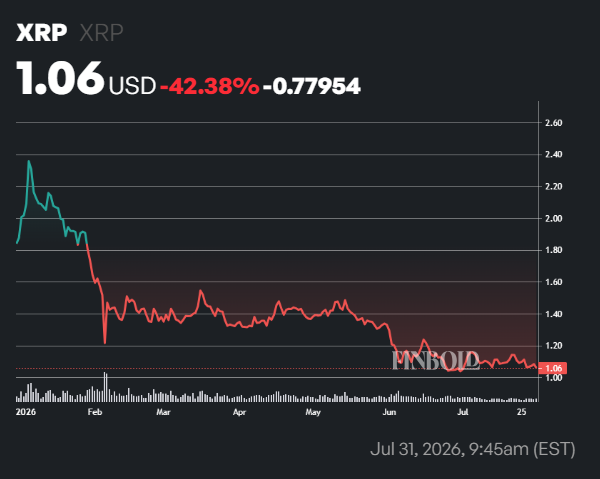
XRP YTD chart. Source: Finbold
With XRP price still trapped in a bear market, characterized by lower highs and lower lows on the weekly time frame, a potential bottom could be formed amid reduced Binance reserves. Furthermore, XRP reserve on Binance has been dropping over the past three months, to roughly 2.6 billion at the time of publication from over 2.77 billion in earlier May, according to metrics from CryptoQuant.
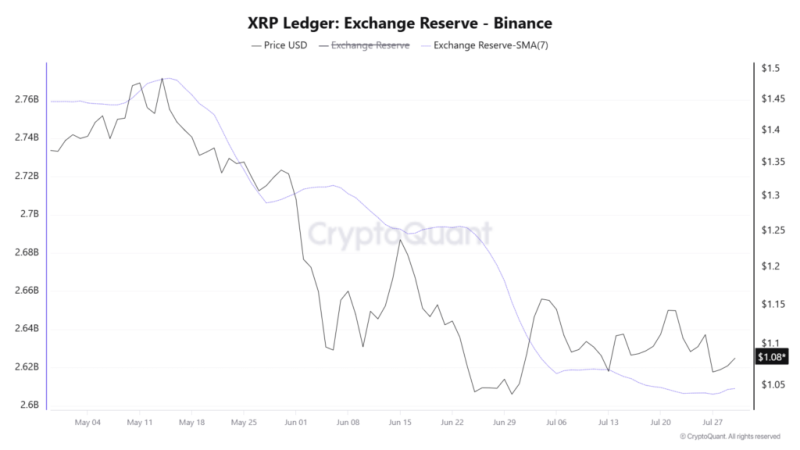
XRP Binance reserve 7-day SMA. Source: CryptoQuant
As such, the token’s price could experience reduced selling pressure if the exchange’s withdrawal transaction share keeps rising amid reduced reserves.