ChatGPT has revealed the best time to buy XRP is over the coming weeks, as the token continues to attract institutional interest amid improving regulatory clarity.
On July 28, ChatGPT highlighted that the most attractive buying opportunity for XRP is after the next meaningful market correction over the next 2 to 8 weeks.
“The next 2–8 weeks could present the most attractive opportunity to buy XRP, provided the cryptocurrency experiences a meaningful correction into key support levels,” ChatGPT asserted.
Additionally, OpenAI’s Large Language Model (LLM) identified the liquidity range between $1.00 and $1.05 as the optimal buying zone.
“Based on current technical support, the preferred accumulation range is between $1.00 and $1.05, while a deeper pullback into the $0.92–$1.00 zone would represent an even stronger long-term buying opportunity, assuming XRP’s underlying fundamentals remain intact,” the AI concluded.
The LLM noted that XRP investors would achieve a more favorable risk-reward scenario if they bought the altcoin after a pullback into an established support level instead of chasing momentum during rallies.
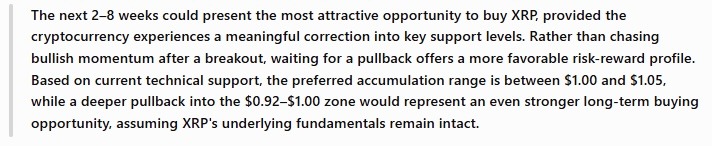
Optimal time to buy XRP. Source: ChatGPT
However, the AI suggested that if several bullish catalysts occur simultaneously, without XRP price having dropped lower, investors can opt to purchase. Some of the bullish developments include continued institutional adoption, a renewed bullish cycle led by Bitcoin (BTC), additional regulatory clarity for digital assets, and increased activity on the XRP Ledger (XRPL).
XRP price analysis and outlook
XRP price has dropped over 42% year-to-date (YTD) to trade at approximately $1.05 at the time of publication. The token fell over 5% during the past 24 hours, with trading volume across the same time frame around $1.39 billion at press time.
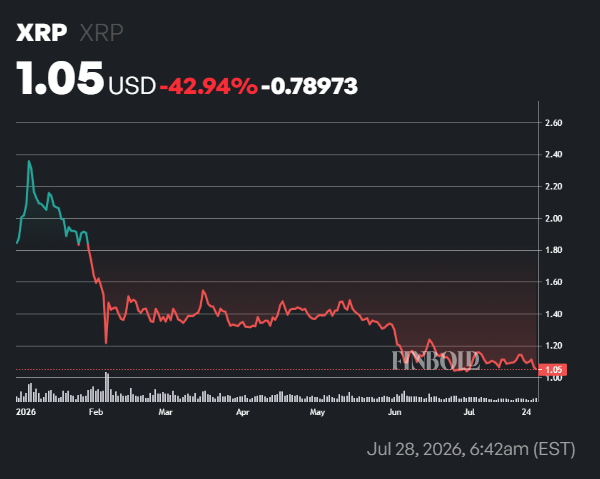
XRP YTD chart. Source: Finbold
As such, the token has already entered ChatGPT’s buy zone, which may last over the coming weeks. Although the token’s price is trading inside an optimal buying zone, ChatGPT concluded that gradual accumulation through dollar-cost averaging (DCA) could help investors reduce timing risks while maintaining exposure.