
Bitcoin enters the weekend near $60,000 after sticky inflation, heavy ETF outflows, and a failed defense of the $59,000-$62,000 zone. The May PCE print gave the market a reason to sell, but the real damage came from positioning.
Core PCE came in at 3.4% year over year, above the Fed’s 2% target but broadly in line with economists’ expectations.
The June 26 options expiry is the structurally heavier event, with Deribit data showing over $10.6 billion in $BTC options expiring, with roughly 80% of that open interest out of the money and max pain sitting in the low $70,000s.
With $BTC trading near $60,000, the gap between spot and max pain reflects how much positioning has been stranded above the current price.
The $60,000 put strike carried about $450 million in open interest heading into expiry, making it a level the market has been orbiting all week. Once expiry clears, that overhang lifts and the market finds a cleaner base to work from.
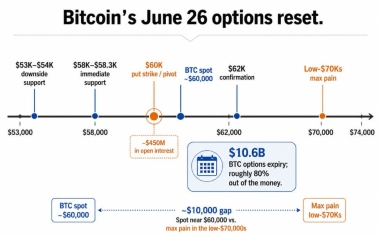 18:25Claude respondeu: Bitcoin’s June 26 options expiry totals $10.Bitcoin’s June 26 options expiry totals $10.6 billion, with spot near $60,000 roughly $10,000 below max pain and 80% of positions out of the money.
What the liquidation flush means
Nearly $1 billion in crypto futures liquidations occurred within 24 hours after $BTC dipped below $60,000, with longs absorbing the largest share.
Lacie Zhang, research analyst at Bitget Wallet, noted that the flush had already removed excess long positioning, leaving the market on a structurally cleaner base than the $58,000 to $60,000 range implies.
$BTC dominance is holding near 55% according to live CoinGecko data, with $BTC and ETH showing stronger holder conviction and contained sell-side supply, while selling in mid- and small-cap altcoins has been more concentrated.
Blue-chip L1s and yield-generating sectors have also attracted defensive capital from investors choosing to stay productive within crypto.
Zhang frames this as capital consolidating into higher-quality assets, a pattern that has historically appeared closer to recovery phases, with prolonged weakness tending to produce far broader deterioration in breadth.
$BTC dominance holding while prices correct points toward repositioning within crypto, with capital staying selective and concentrated in the highest-conviction assets.
The ETF channel goes quiet
Farside Investors’ data show spot Bitcoin ETFs posted over $1.1 billion in outflows between June 24 and 25. That two-day stack created a visible, recurring sell channel during US trading hours, with redemptions translating directly into spot supply.
ETF trading is paused until June 29, which makes the next 72 hours a test of native crypto liquidity, as spot buyers, perpetual futures markets, and on-chain holders operate without fresh institutional redemption flow hitting the bid.
Zhang puts the July catalyst: if ETF outflows stabilize after expiry and volatility normalizes, Bitcoin could post a stronger recovery than the current consensus implies.
| Driver | What happened | Weekend implication |
|---|---|---|
| PCE inflation | Core PCE came in at 3.4% YoY, sticky but broadly expected | Important macro backdrop, but not the dominant weekend driver |
| Options expiry | More than $10.6B in $BTC options expired, with about 80% OTM | Removes a major positioning overhang and resets dealer/trader exposure |
| Liquidations | Nearly $1B in crypto futures liquidations after $BTC slipped below $60K | Suggests excess leverage may already be flushed |
| ETF outflows | More than $1.1B left spot Bitcoin ETFs on June 24–25 | Created weekday sell pressure, but the channel pauses over the weekend |
| $BTC dominance | $BTC dominance near 55% while prices correct | Points to selective consolidation into higher-quality crypto assets, not full market exit |
The levels that decide it
$BTC‘s intraday low on June 25 reached $58,189, and live data shows an intraday low near $58,319, making $58,000 to $58,300 the weekend’s immediate support band.
A clean break below $58,000 that holds through the session would show that sellers have more to do.
Holding $58,000 opens the path to $60,000, the psychological pivot that also sits at the heaviest put strike from the June 26 expiry. Getting back above $60,000 neutralizes the breakdown narrative.
The first reclaim zone sits at $60,600-$61,000, near the current intraday high of $60,621. A move above that level shows buyers can do more than defend a wick.
From there, $62,000 becomes the key confirmation, as $BTC back above $62,000 reframes the weekend as a sweep below the old range, a distinction that carries weight for how July opens.
The 72 hours that decide the July start
In the bull case, $BTC holds $58,000, reclaims $60,600-$61,000, and pushes toward $62,000 before June 29. That sequence supports the forced-selling-exhaustion read, with long positioning cleared, expiry settled, and native liquidity absorbing the remaining supply.
Under those conditions, July positioning can reset from a cleaner base, with stabilizing ETF outflows reinforcing a recovery the current consensus has underpriced.
The $66,000 to $67,000 zone becomes relevant only after $62,000 is reclaimed and held.
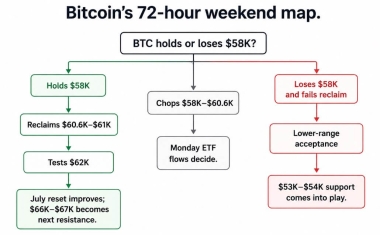 Bitcoin’s weekend hinges on $58,000: hold it and the path to $62,000 opens; lose it and $53,000-$54,000 comes into play.
In the bear case, $BTC loses $58,000 and holds below it through the weekend session. That reframes the recent move from an exhaustion wick into lower-range acceptance, opening the path toward $53,000 to $54,000 as the next serious support cluster.
The liquidation flush Zhang describes would prove a pause, with more deleveraging required before July can build a stable base.
If redemptions resume at the June 29 open and post-expiry positioning stays short-leaning, $BTC opens the week with structural weakness, resetting the bull case for a later date.
Bitcoin’s July direction will be shaped by how flows, on-chain accumulation, and positioning behave in the 72 hours after expiry settles. The macro data is already known and priced, while the positioning reset is still being decided.