According to The Seoul Standard, a joint report by RedStone and Kaia published September 29, 2026, the Korean won is the second most traded currency in the digital asset space behind only the dollar, with KRW pairs accounting for roughly 30% of global spot volume. However, none of that liquidity can be deployed as collateral in onchain lending or DeFi markets.
There is no legally recognized won stablecoin, and the cost of that gap is now measurable: net stablecoin outflows from Korea’s five licensed exchanges have run negative for eighteen consecutive months, reaching a cumulative KRW 14.92 trillion, or approximately $10.4 billion.
That comes down to two pieces of legislation moving at different speeds. The tokenized securities framework passed the National Assembly in January 2026 and takes effect in February 2027. The Digital Asset Basic Act, the statute that would license a won stablecoin, remains in committee, stalled on a single question: whether KRW stablecoin issuance is reserved for bank-led consortiums or opened to fintech issuers.
Korea has legislated its capital markets layer before its payments layer
The sequencing matters. A securities registry goes live in February 2027, but without a licensed won settlement token to settle in, it is finished infrastructure waiting on an unfinished political argument. Meanwhile, Korean capital continues to leave.
Over the same eighteen-month period, the share of active crypto users fell from 35.7% to 19.5% and aggregate holdings dropped 54.7%, as retail money rotated into a KOSPI that gained 114% over twelve months.
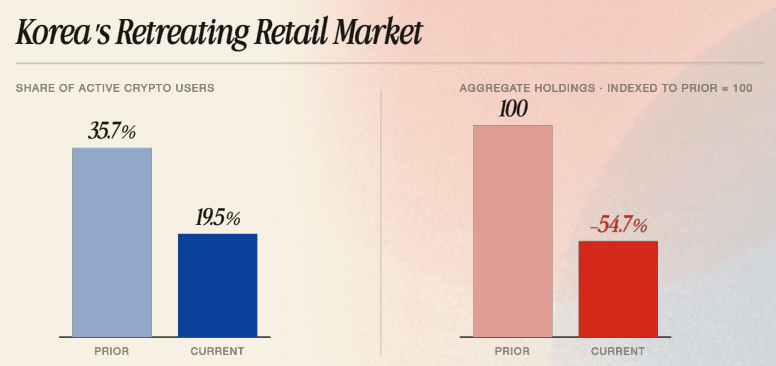
Korea’s Retreating Retail Market. Source: The Seoul Standard
Regulatory clarity turns a won stablecoin from a payment instrument into DeFi collateral. Collateral feeds lending markets and tokenized asset settlement. That circuit mobilizes the stock of retail and corporate won deposits sitting inert today, a pool the report describes as structurally large relative to any comparable new market entering the non-USD stablecoin space.
Regional stablecoin frameworks are already live as Korea’s DABA remains in committee
Korea is arriving late to a regional shift already underway. Hong Kong granted its first two stablecoin issuer licenses in April 2026, while Japan launched JPYC, the first regulated yen-pegged stablecoin, in October 2025. Singapore, which finalized its framework in 2023, is now legislating it into force.
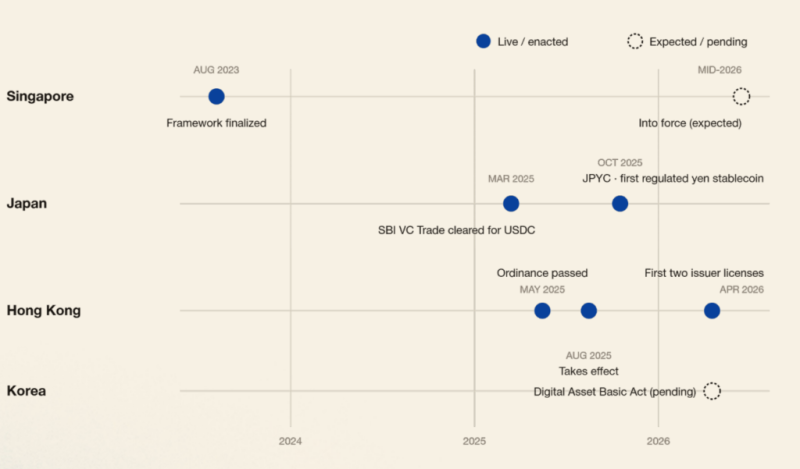
Asia Moves First timeline. Source: The Seoul Standard
Korea enters this shift with deeper native liquidity than any comparable new market, but without the legal infrastructure to put it to work onchain.
The report outlines three scenarios. The base case sees DABA pass in late 2026 or early 2027 with bank-majority issuance and first won stablecoin licenses following in 2027, converging with the STO framework within about a year.
The bull case sees broad issuer eligibility, spot ETF approval, and Korea becoming the first major Asian market where a local-currency stablecoin, tokenized securities, and institutional custody all operate under one statute.
The bear case sees DABA slip into 2027 or beyond, with offshore KRW-linked products filling the vacuum and the tokenized securities framework arriving in February 2027 with thin issuance because the settlement asset it was designed around still has no legal basis.
Featured image via Shutterstock.